
On Assignment
Branching out 018

I love the feeling of motion, whether it’s dancing, walking, train trips, or the motion of my mind. And while I consider myself more of a cat person, my brain often feels like a dog. It escapes the leash, races off the path, and plunges into the forest, following scents and squirrels and squiggles of sunlight. For a while, it’s exciting! But eventually the puppy needs to be called back.
One thing that allows for both the fun-run and the calming tether is a thoughtful, well-timed assignment, and one came my way recently via my work as a Fellow with the Creature Conserve Mentorship Program. At its most basic, the idea behind the Century Project assignment is simple: make 100 of something.
Rather than pure repetition, however, the focus of the Century Project is iteration. Create 100 circles on a notecard, for example, and make each one different. By responding immediately to the successes and failures of each new attempt, the work changes course and evolves rapidly. It becomes a visual conversation with an idea, and like talking (and walking!) with a friend who asks insightful questions, it’s possible to end up somewhere unexpected and wonderfully satisfying.
The Century Project was intended to support the Mentees in our program as they develop their work. I chose to apply the process to my Fellowship project, called CoLab, too. CoLab will bring a small group of artists and scientists together to investigate real-world biodiversity questions with a focus on mutualisms—biological relationships in which all participating life forms benefit. Think clownfish and anemones, fig trees and fig wasps, or any of the thousands of species of lichens. These relationships exemplify the sort of unexpected, innovative, and complex solutions that can emerge from collaboration between what might at first seem unlikely partners.
I was not at all sure how to use the Century Project assignment for CoLab, or where it might lead me. In her book The Extended Mind, Annie Murphy Paul suggests we find ways to think outside of our heads, to use our hands, bodies, spaces, and communities. I enjoy collaborating with our local landscape, and given its recent abundant offering, I started with walnuts.
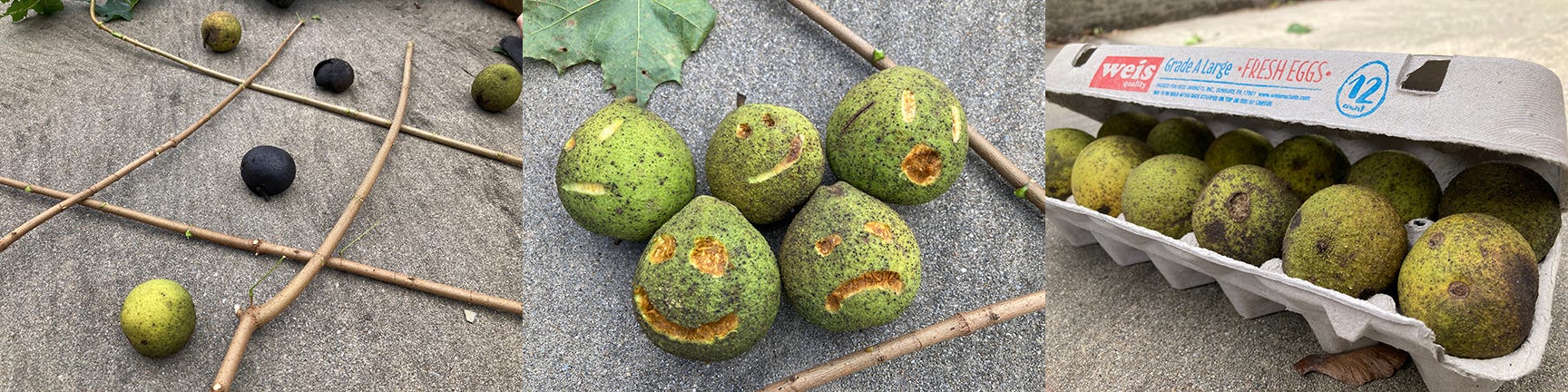
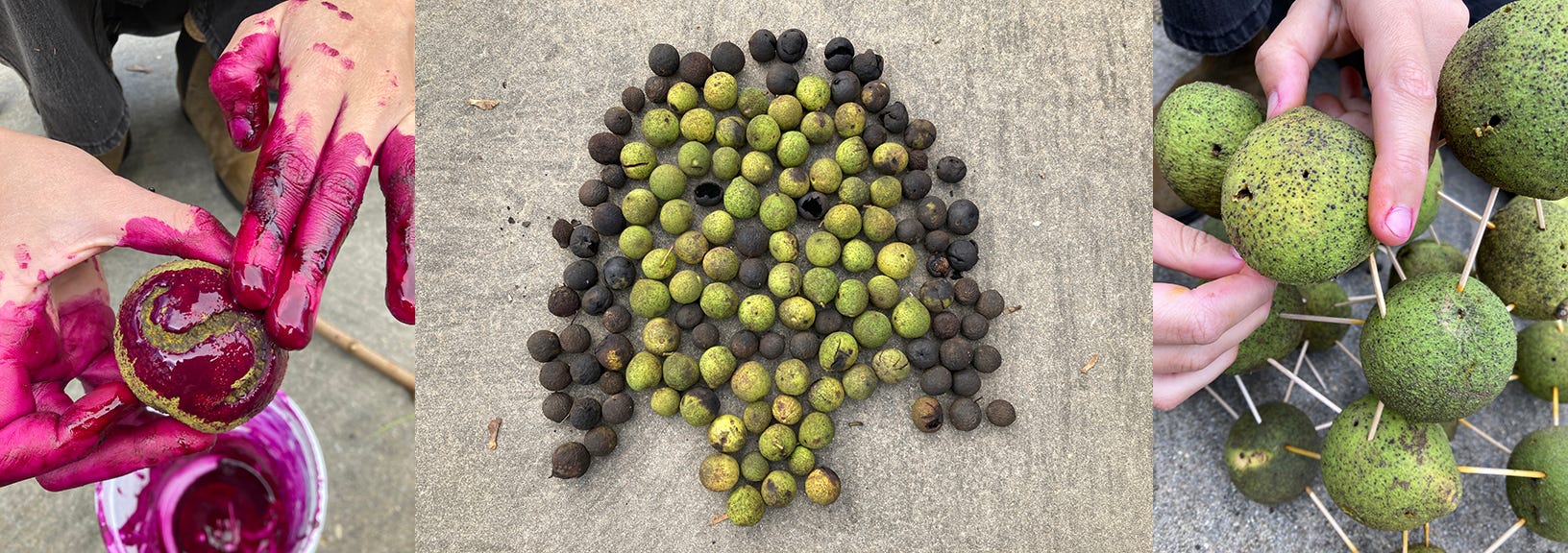
My older daughter Marina was home visiting, and helped me start things off. We worked quickly and closely, often playing off each other’s ideas without a word. Cutting into the walnut husks with straight knives didn’t allow us to create much detail, for example, so Marina ran off to find her wood carving tools—and then carved a whole walnut alphabet. After using the round walnut to print on flat paper made a mess, I dug out some fabric. She smeared on pokeberry ink, then held each inky walnut steady as I draped and pressed the fabric over them. We also tried to create a structure we could sit in, but settled for multiple smaller—and very sturdy—towers of various configurations. It was all weirdly personal, and weirdly fun.
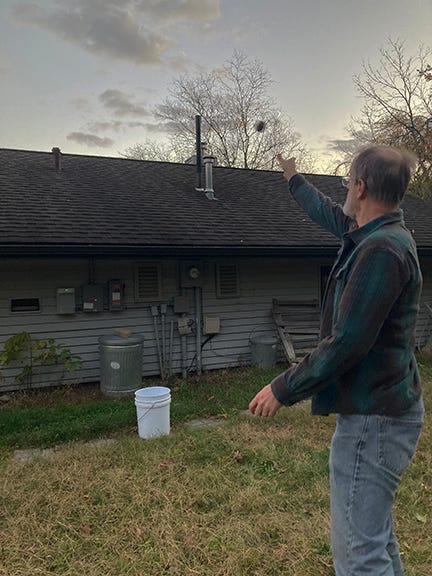
One evening my husband came out to play, too. He’s more comfortable with a cello in his hands than sports equipment, but still, his instincts were different than mine or Marina’s. We played walnut horseshoes, competed to see who could hit a narrow post with walnuts, and rolled walnuts off the roof to land them in a bucket below. It turns out that lots of walnuts rolling off the roof at once makes a fabulous rumbly musical sound, which I recorded. Absurd. And again, fun.
So that was my first discovery: play. And what seems to be a prerequisite, trust. The trust I have developed with my daughter and husband helped make it possible for us to play together.
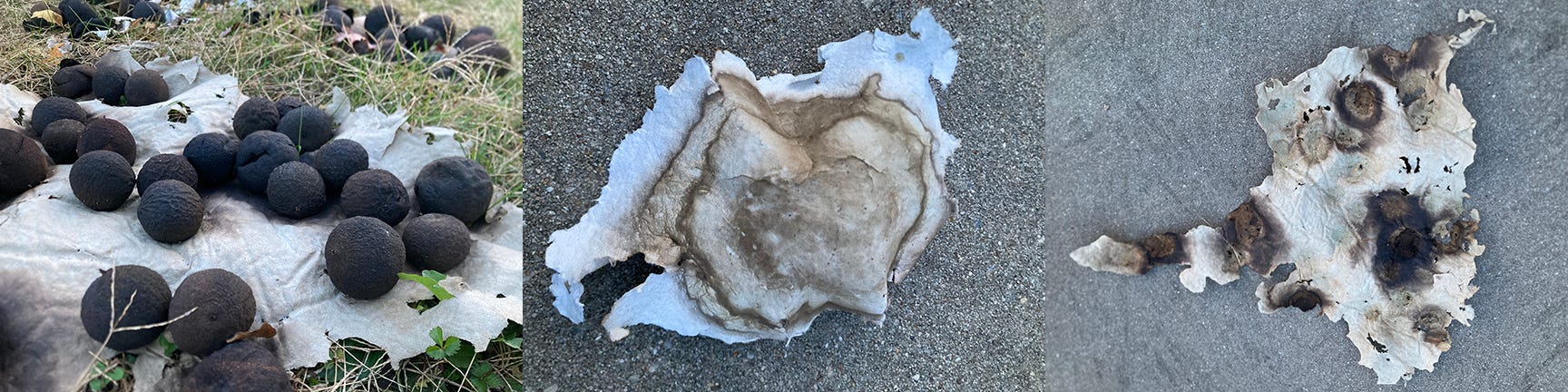
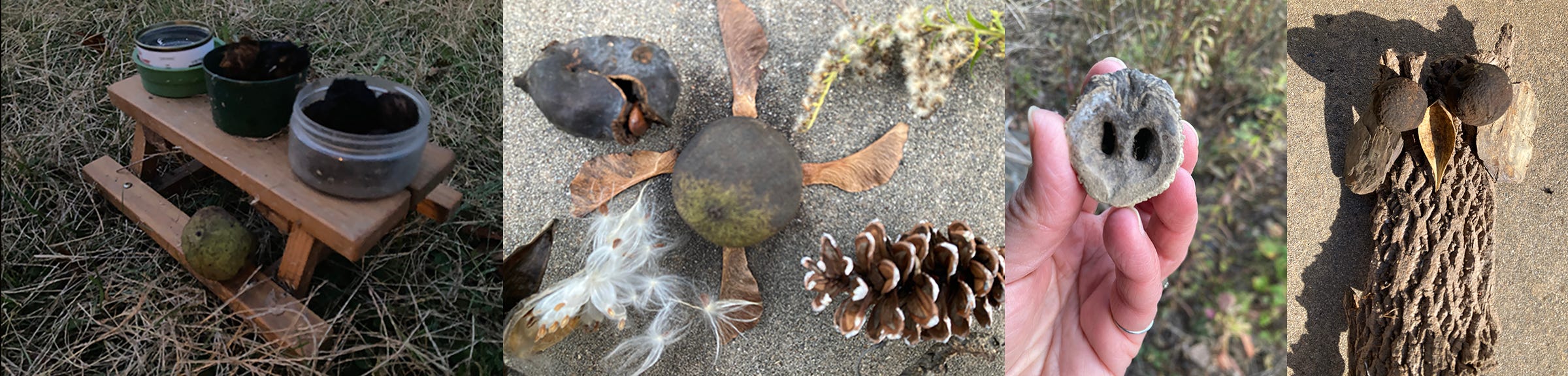
At the halfway point, I wasn’t sure I’d make it to 100. Then, a couple of things happened.
The week Hurricane Melissa hit Jamaica, when the ceaseless churning of our world felt particularly out of control, I was already thinking about spirals. I took a break from my usual schedule to see Thomas Little (a previous Twig & Ink guest, finally in real life!) give a thought-provoking, educational, and thoroughly entertaining presentation about his work. Among other stories and connections, Thomas’s comments about spirals prompted me to circle back and look at familiar things in a new way. We also made Gobolinks using the ink Thomas makes from guns. I didn’t think about walnuts at all.
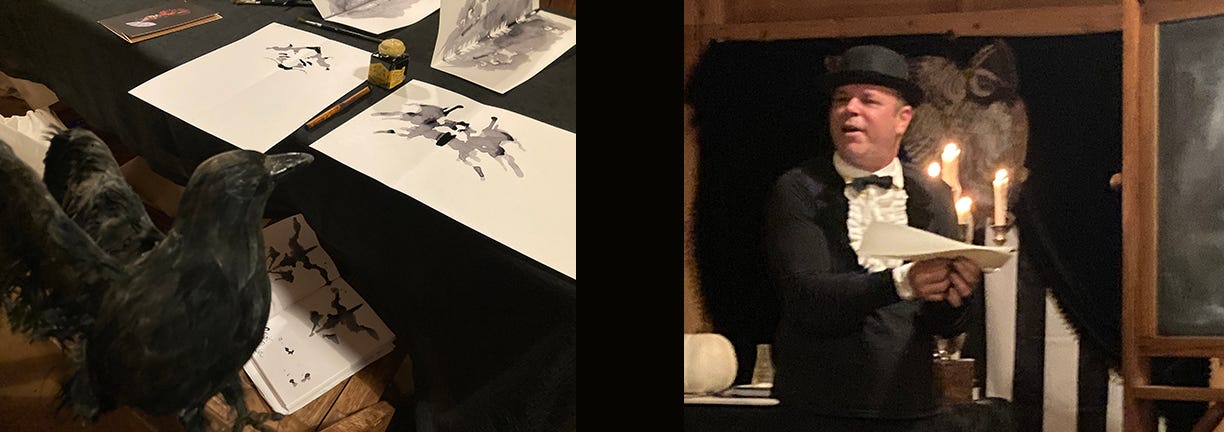
The next day, while preparing artwork for an upcoming show, I broke the large sheet of glass I needed to frame it.
We can talk about how this provides an apt metaphor for the fragility of nature—the care and protection of which is, after all, at the core of all these investigations—or how trying to save something so delicate that even with our best intentions, it degrades in our hands. We can talk about the need to witness this fragility, sit with it, stay with it, even when it feels scary. But ^*%&@!! I had only a few days before the show, and no back-up piece of glass. This mistake involved time and money I hadn’t accounted for. I walked out of the room and shut the door.
My mood and the evening turned dark. Maybe watercolors and oil pastels would help? Puddles of color seemed about my speed, but I wanted to clean up the glass first. I had hoped I could tidy up the edges of the largest piece and salvage it for something else, but as I lifted it, it split into smaller shards. In a flash of disbelief and utter frustration, a small “what if” voice came out of hiding. Maybe with some walnut ink thrown into the mix, this could be the next step in my Century Project?
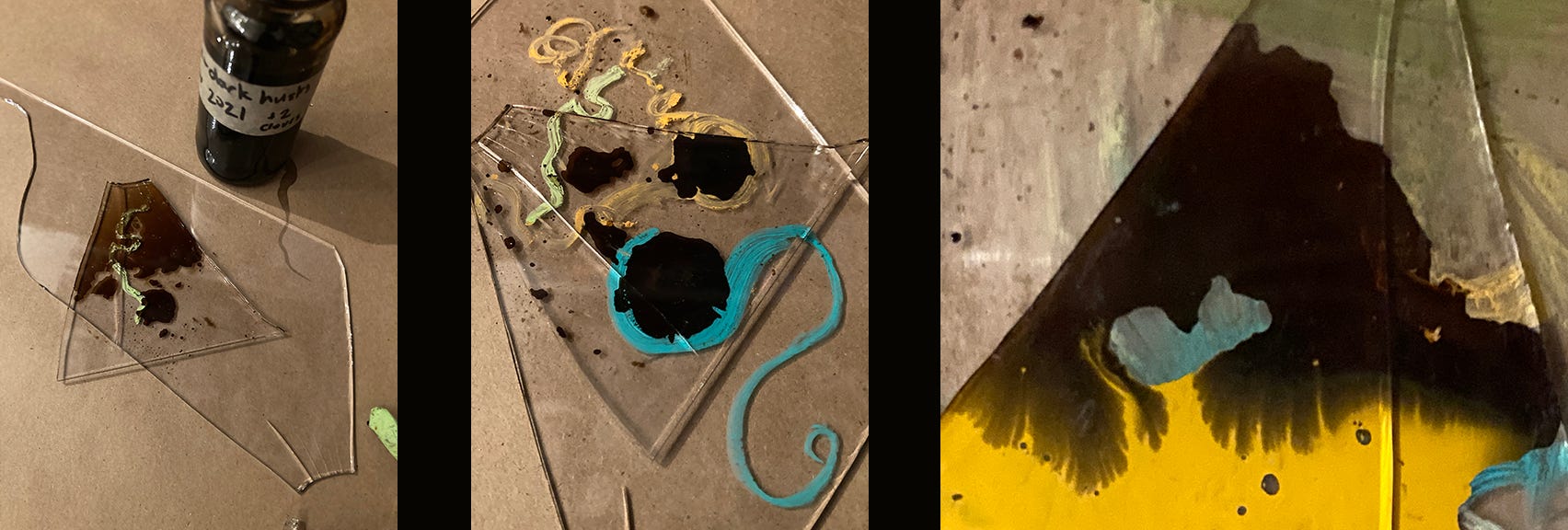
That moment of curiosity allowed for an explosion of layers, motion, pressure, transparency, reflection, opposition, colors, and more.
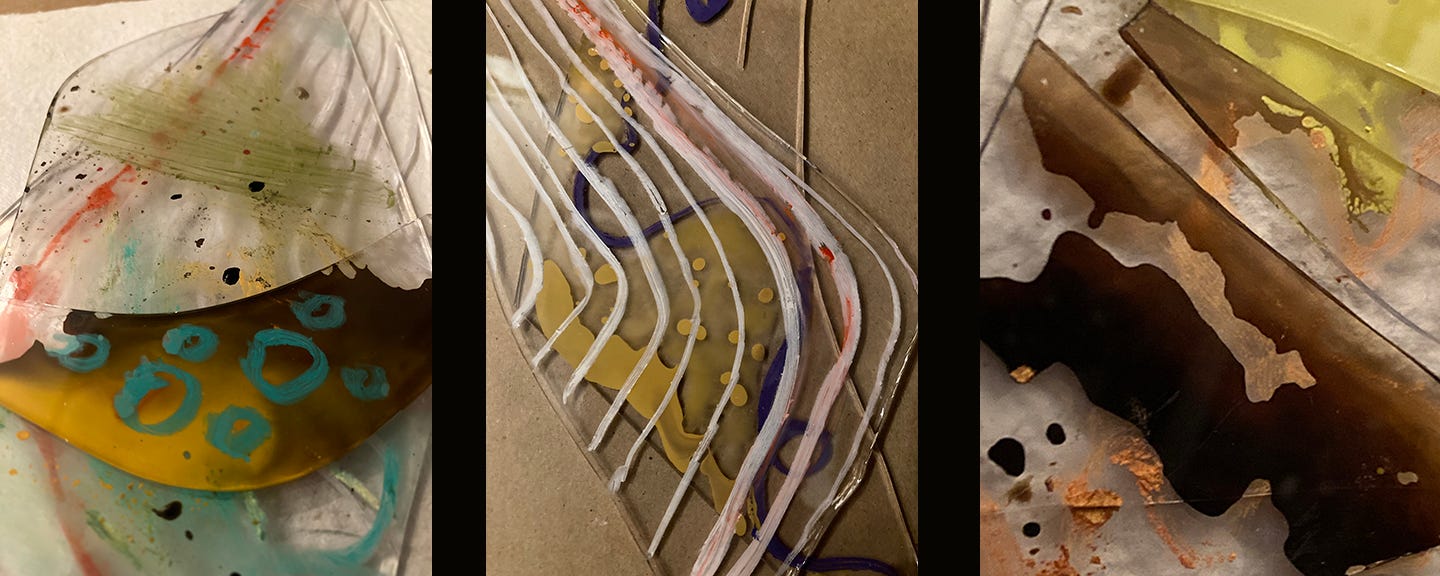
And suddenly, just as I’d hoped, I found myself somewhere new, absolutely unanticipated, and full of possibility.
Special thanks to Derek Russell (and more here!) for offering this assignment to the 2025-2026 Creature Conserve Mentee cohort. Huge thanks also to my family and everyone else who talked, played, and experimented with me these past few weeks. I promise, no more walnuts. At least for now.
My experiments with glass were inspired in part by an installation I happened upon years ago, Peter Bynum’s illuminated windows outside the New York Public Library.
The art I was framing was for the Berks Art Alliance 46th Open Juried Exhibition, and will be on display at Goggleworks Center for the Arts until December 1st. It’s a beautiful show, and I’m delighted to share that my piece received an Honorable Mention!
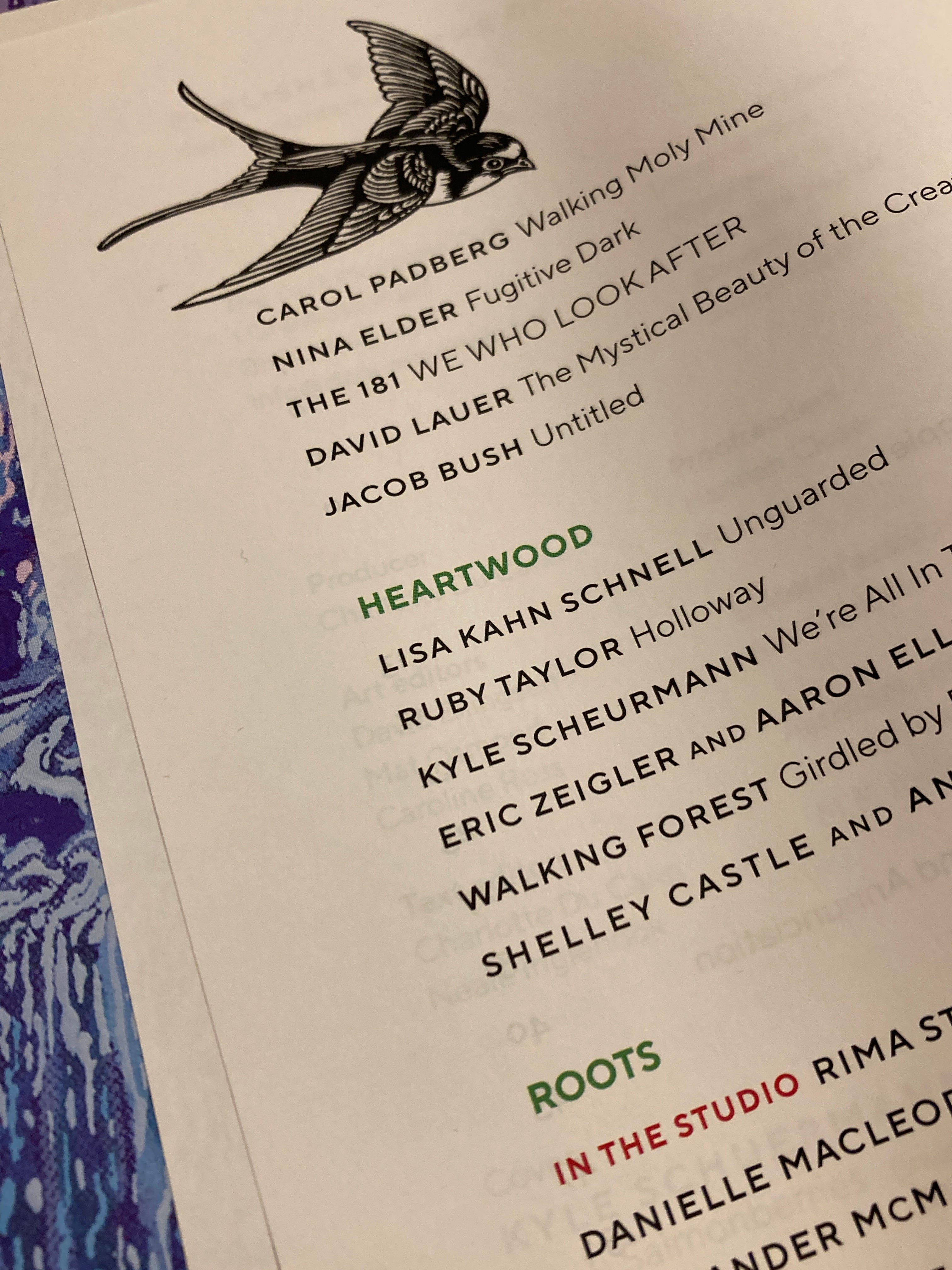
Dark Mountain 28: Uncivilised Art is officially out! With my art and writing in it! I have found so much inspiration in these pages, including work by Thomas Little and Aaron Ellison, both featured guests on Twig & Ink. Also, this issue is organized like a tree! I melted when I saw where they placed my piece:
Thanks for reading!
All photos by Lisa Kahn Schnell, 2025.
Accidents happen and yes by the example you give, adding your loved ones all types of "new" creation came forth. Breaking through dark thoughts often take us to new lights that feed our true creativity. Looking forward to more accidents that mend the soul.
I really loved reading this, Lisa. Felt like I was on a creative journey with you, and it felt very nourishing. Thank you for sharing.