
Restoring Relationships
Featuring: Lee Lee Leonard

The layers of experience, knowledge, and connections that emerge when people respond to a simple question always amazes me. There’s so much going on beneath the surface!
This month’s guest, Lee Lee Leonard, once mentioned that she soaks everything around her in like a sponge, and then releases it back out to the world. When I feel like I’m going in too many directions at once, this image helps me appreciate the insights, however complex or simple, that each of us bring to the collaborative relationships we establish with our local human and more-than-human communities.
Interview: Lee Lee Leonard
What sort of work do you do?
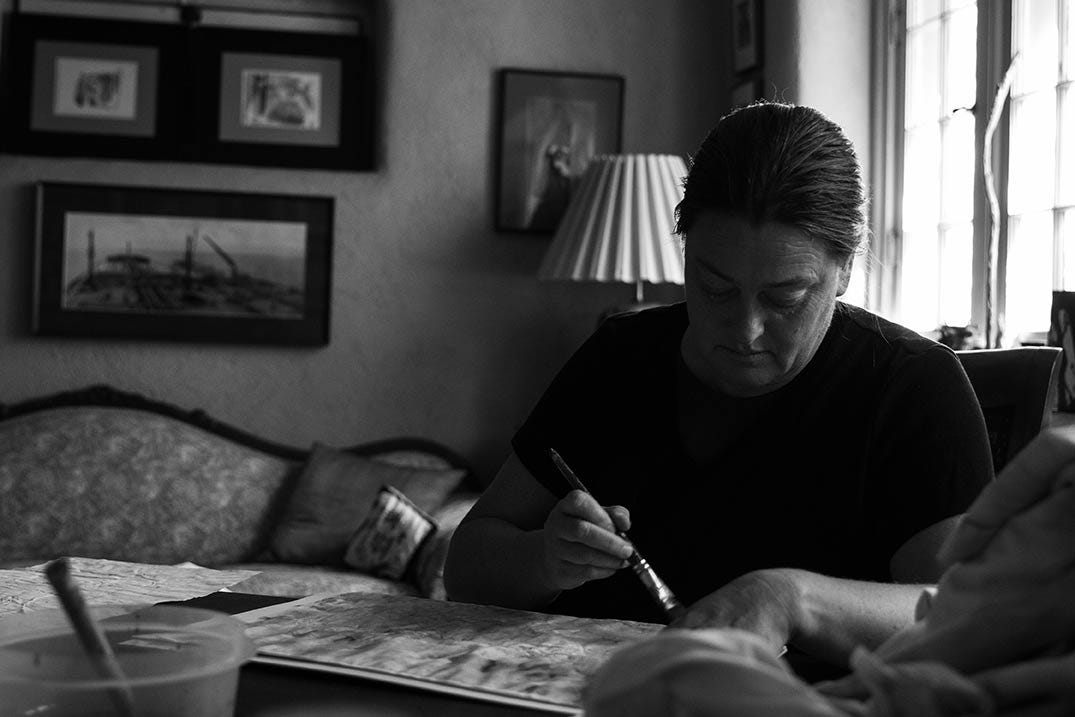
As a visual artist, I create artworks solo in my studio, as well as community-based work that is immersed in the landscape. Plants play a primary role in the process of bringing people together to share stories and ways of developing relationships with the habitats that sustain us.
As an individual artist, I weave together a myriad of organizations to create collaborations that bridge art and ecology to engage communities on how we can all participate in restoring landscapes while strengthening communities.
How are science, art, and writing part of your work, and how is the interaction between these areas important to you?
We suffer a problem with access to scientific information. It’s hard for people to find information without a concerted effort, and scientific language is hard to understand. Art plays a significant role in translating hard-to-digest information to help engage people, especially around pressing issues like climate. Writing is essentially storytelling, and because we are passionate about free access to information, we spend a lot of time considering how to share stories. The concept of libraries as accessible depositories of information is our starting point as we think of ways to insert information into public spheres.
When you say we suffer a problem with access to scientific information, what particular aspects of science feel especially important to you to understand and share?
Observation and contextualization are vital for both science and art, and are tools we can encourage people to use as we navigate challenges presented by the over-consumption that has become the norm.
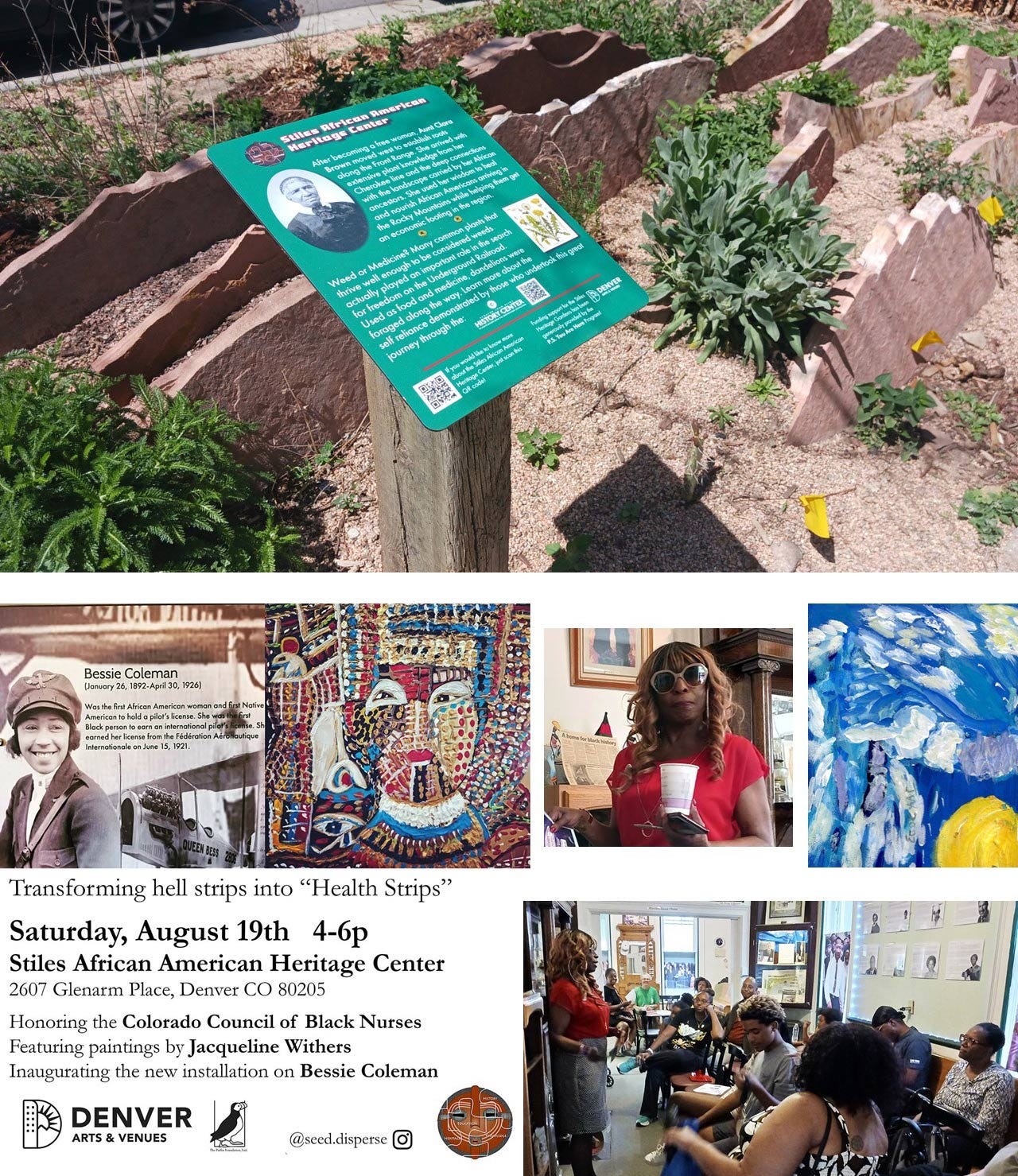
For example, we are working with the Stiles African American Heritage Center, the Colorado Native Plant Society, the Colorado Council of Black Nurses to transform ‘hell strips’ into Health Strips around the historically black urban neighborhoods in Denver. Reviving plant communities in urban corridors will work hand in hand with plant ID signs that will direct people to information about specific plants from African American perspectives, including historical uses. In this way, we are weaving together work from botanists, historians, health workers, and herbalists to offer a well-rounded profile of plants significant for Black communities.
Now I’m intrigued: What is a hell strip and how does it transform into a Health Strip?
Here in Denver, the land between sidewalks and the street are city-owned property that the adjacent homeowners are required to tend. They often fall by the wayside and end up neglected in central urban areas, hence the name hell strip. We encourage neighbors to revive these wee plots of land with native plants (which will not need additional care once established) in order to increase habitat corridors through central neighborhoods. We do this by offering free seeds from the Living Seed Library, which is the garden we established around the Stiles African American Heritage Center with funding from Denver Arts & Venues and the People and Pollinators Action Network (an incredible organization that spearheaded passing legislation wherein pollinators are considered wildlife that enjoy state protections).
Through seed dispersal and education programs, we invite community members to transform the spaces in front of their homes into Health Strips that promote the health of our local environment as well as healthy bodies. Partnering with the Colorado Council of Black Nurses, we are engaging Black herbalists to compose material centered on African American plant relationships that will be linked via QR code on plant identification signs that also display designs of quilt squares that were used to guide freedom seekers along the Underground Railroad. Cultivating care for our urban landscapes and the species with whom we share these spaces is the core of the work. My part is to conceive of the frameworks for the garden installations as well as the open-source sharing of resources and information, including the biological information coded into seeds.
This combination of restoration and community is especially interesting to me. I’d love to hear more about your work in this area.
I feel that restoring our relationship with habitats is the most important focus. Then we can apply it to any landscape, whether we are indigenous to it or not. I’m drawn to the term ‘re-matriation,’ where we work to return the land to itself—the proverbial Mother Earth or Pacha Mama. Art is an ideal tool for this because it allows us unstructured spaces in which we may explore the nature of the world around us in order to deepen our understanding of it.
Art is, at its core, creative. As a mother, I discerned how much of our day-to-day work is creative, even as it is not recognized as ‘art’ in the institutional sense. I started to recognize the ways various communities center these creative acts as the fiber of what defines their culture. Motherhood allowed me to step away from the hierarchy of what is deemed ‘fine’ art, so that I could embrace cooking, herbalism, agriculture, and craft as art forms in their own right and see them as important as the boxed-in academic definition of art. Within these broadened definitions, a big part of my creative practice is to conceive structures (frameworks) which connect practitioners within a community so their creative acts may amplify the capacity for understanding the ways we are tied to surrounding habitats in order to cultivate care enough to restore them.
In working with the Stiles African American Heritage Center, for example, it is not my place to tell the stories because I’m not Black. But these histories are important for everyone to learn because African Americans have made tremendous contributions to American society. So, my role is to come up with ways to deepen relationships with the natural world through accessible and diversified information, and to cultivate the plants in ways that they may easily be shared.
Could you share more about your visual art practice?
I’m a strong believer that observational drawing is one of the best learning tools we can provide for learning about the inter-related forms that make up a species and its relationship with the world around it. Slowing down to complete a drawing from focused attention opens the space to develop a meditative practice centered on attention towards the natural world around us.
Part of the information we provide in the Health Strips is open-source images of the wildlife each plant supports. My favorite source of imagery is drawn from these free-to-use photographs that have been gifted by their creators. We like to share these images with local students so they may learn more about the food webs that function in urban spheres by attaching images of wildlife to the plants that we are sharing from the garden.
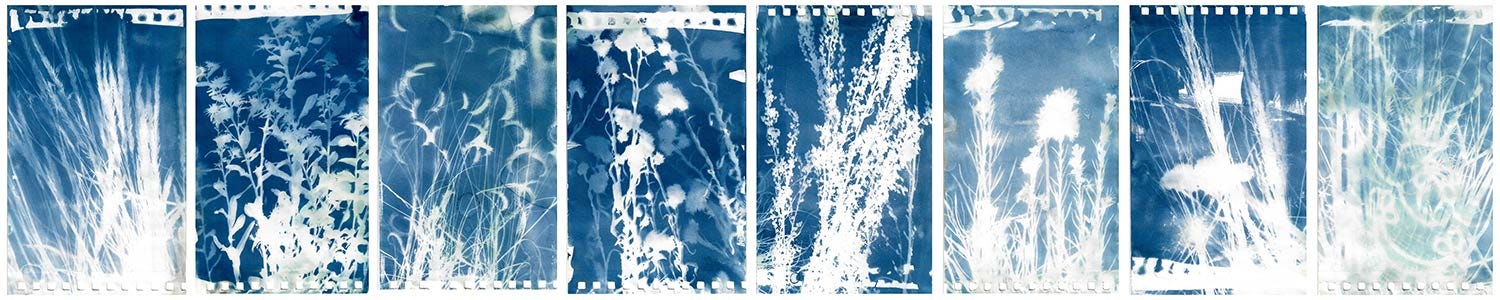
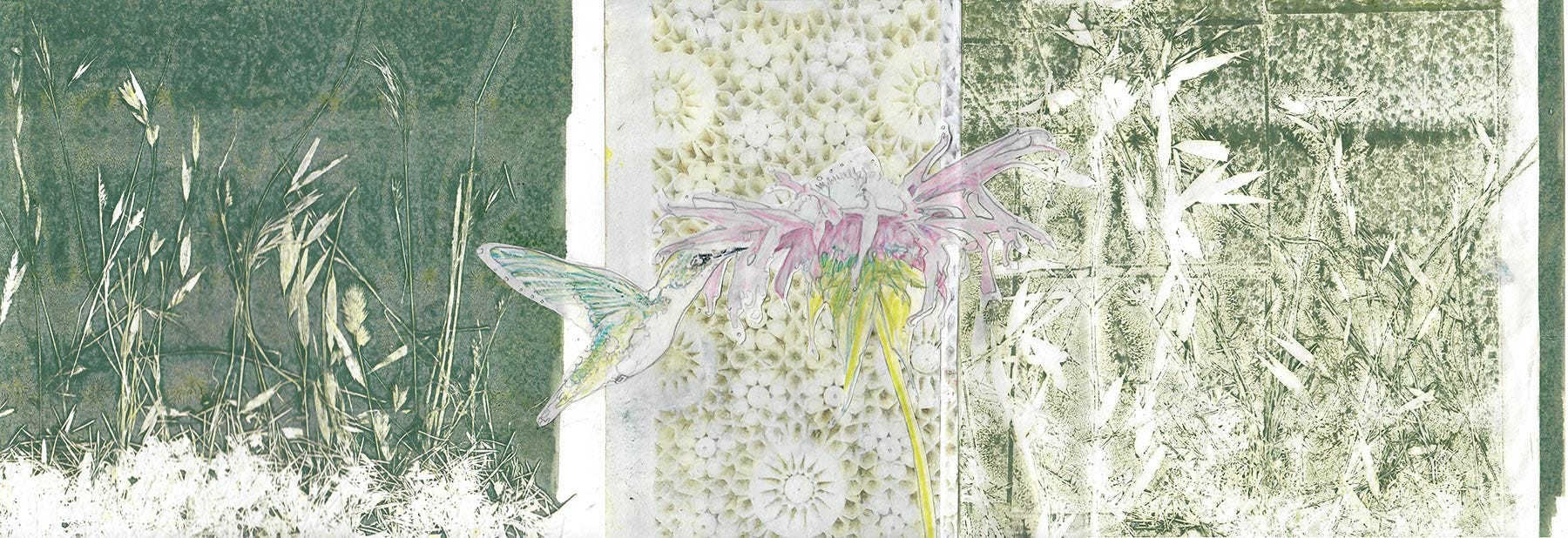
My own figurative work is drawn from this material. Process is vital to my visual arts practice as well. I’m learning how to make pigments and plant dyes in order to know the plants better. I love making cyanotypes in the field so as not to disturb the plants, then incorporating them into mixed media collages. Integrating printmaking and photography as mark making tools is one of my favorite ways to insert direct representations of the world and to contextualize the need and practice for reparations. I also love making marks with fire, submersion, burial, and exposure to bring elemental textures to the works.
What aspect of your work has the most personal meaning for you?
Being a mom has become the core of my practice. I work in close cohort with my teenage son, Thatcher Gray, which allows space for deep consideration of future generations. Together, we trace ancestral practices from our own heritage as well as the lineages who have been the traditional caretakers of the lands in which we work.
Is there a particular environmental problem that feels important to you? What do you do about that?
We are primarily focused on water in steppe ecologies. Farms interlaced with irrigation ditches known as Acequias still flourish by directing water through ancient canal systems into fields. The water floods the fields and in turn, saturates the soil and seeps back into the ground to replenish aquifers that feed springs and rivers downstream. Because water is pulled from rivers and directed across surrounding fields, it broadens the alluvial plain to support wildlife corridors in a rare example of farming that actually benefits the natural world.
Could you talk more about Acequias? Also, who does ‘we’ refer to?
Together with my father and son, we are three generations of Leonards who serve as Acequeros—people who are part of an Acequia community, also known as parcientes—on the Los Lovatos ditch network, the oldest in Taos, New Mexico. Acequia is an Arabic term that roughly translates to ‘the flowing path towards life’ and is the root of the saying, ‘Water is Life’ or ‘El Agua es La Vida.’
Growing up in the Rocky Mountain Steppe, I followed my father, master irrigator of the Blue River Valley around green pastures of the Lazy Shamrock Ranch, while he flood irrigated the high-altitude fields. Thatcher walks in his grandfather’s footsteps by working over 800 irrigated acres alongside an Acequero from Peru.
The core of this practice is sharing resources, which is deeply rooted in Indigenous philosophy and practice from all regions of the world. We learned to lean in to local practices to learn from elders on how to heal relationships with landscapes. Originating in Persia over four thousand years ago, the practice migrated across North Africa and into the Iberian Peninsula during the Arab golden age of engineering. After the Spanish pushed Andalusians back into Morocco, they recognized the value of the practice, maintained the networks and carried it throughout the Americas and the Philippines, where they are still in use from Patagonia through the Andes north through Mexico into southern Colorado.
Most importantly, the essential resource of water is held in the commons. The social structure of the Acequias is such that water is maintained and shared between the people who use it, and is a prime example of a functional community-centered practice that provides nourishment to local citizens.
I love the fact that this practice benefits farms and the natural world! And I’m curious about the commons aspect of it. Are people agreeable to this plan?
People are very agreeable to this plan because it keeps water in their community, and sharing it allows the overall community to thrive. It is a constant battle against corporate interests who want to privatize water so they can profit from it, which I believe is one of the most dangerous ideas we face today. No one should own resources that are essential for life. It is a very functional system when the networks are intact, but it is constantly facing challenges and it takes diligence from local Acequia communities to preserve the practice.
You have also lived in Maine. What sort of work did you do there?
I was eager to shift towards healing landscapes after hearing a talk by Dr. Thomas E. Lovejoy on the importance of restoration at any scale.
In Maine, we became close friends with the Penobscot linguist and poet Carol Dana. We made a connection through Buddhism, which has a saying: “the only constant in this world is change.” This understanding of the constant shift of the world fell in line with the way Penobscot as a language reflects the world around us; there are very few nouns (words that represent a fixed idea). It was through our conversations that I came to understand the traditional relationship with habitats is one that is always evolving in response to the overall shifting of the landscape.
Carol’s teachings are the foundation of how I approach restoration work. She once said, “every plant has a gift,” which echoes loving acceptance common to Buddhism; a stark contrast to the judgement that is often practiced in academic spheres and amplified by ecologists of European descent. When we came across a field of Valerian for example, she would comment with thanks how this plant brought tranquility whereas most local ecologists would simply dismiss it as being from “away” and felt did not belong here. (Carol’s most recent book on the Transformer Tales)
What sort of restoration work did you do there?
My goals in Maine were twofold; I wanted to learn about ecology and I wanted to figure out how best to engage youth in restoration. The Blue Hill Heritage Trust offered a great platform to play around with creative programming that linked arts and the outdoors.
The most effective programming occurred in close collaboration with local schools. When we produced activities outside of schools, they were attended by families who had the existing interest to seek out information on these kinds of activities as well as the time and capacity to attend them. When the programs were inserted into classrooms, ALL kids participate.
We brought native seed heads into classrooms to dissect them and learn dispersal methods. We planted these seeds outdoors in pots at the school to expose them to the winter so they would germinate. In the spring, we took field trips to newly reopened anadromous fish passages that were being restored around the peninsula to plant the seedlings around disturbed grounds of construction sites to re-establish native plant communities along the river shores of fish ladders. At every point of the process, you could feel the relief and excitement expressed by students as they got a dose of nature in the otherwise academic constraints of school.
Are you interested other science-art-writing collaborations with groups or individuals?
Always. Collaboration is the core of my practice. I approach it with an open heart and commence any project by listening. Through learning the specific dynamics of a community and their relationship with habitats, I seek out elders, fellow moms, children, educators, ecologists, chefs, farmers, and other related practitioners to see how we can weave creative frameworks of restoration into existing social structures to augment the care that is already expressed by the community in which we are working. I’ve been called ‘spider-woman’ for the way I cultivate connections between people who are doing admirable work so that we may all move forward together.
What influences and inspires you?
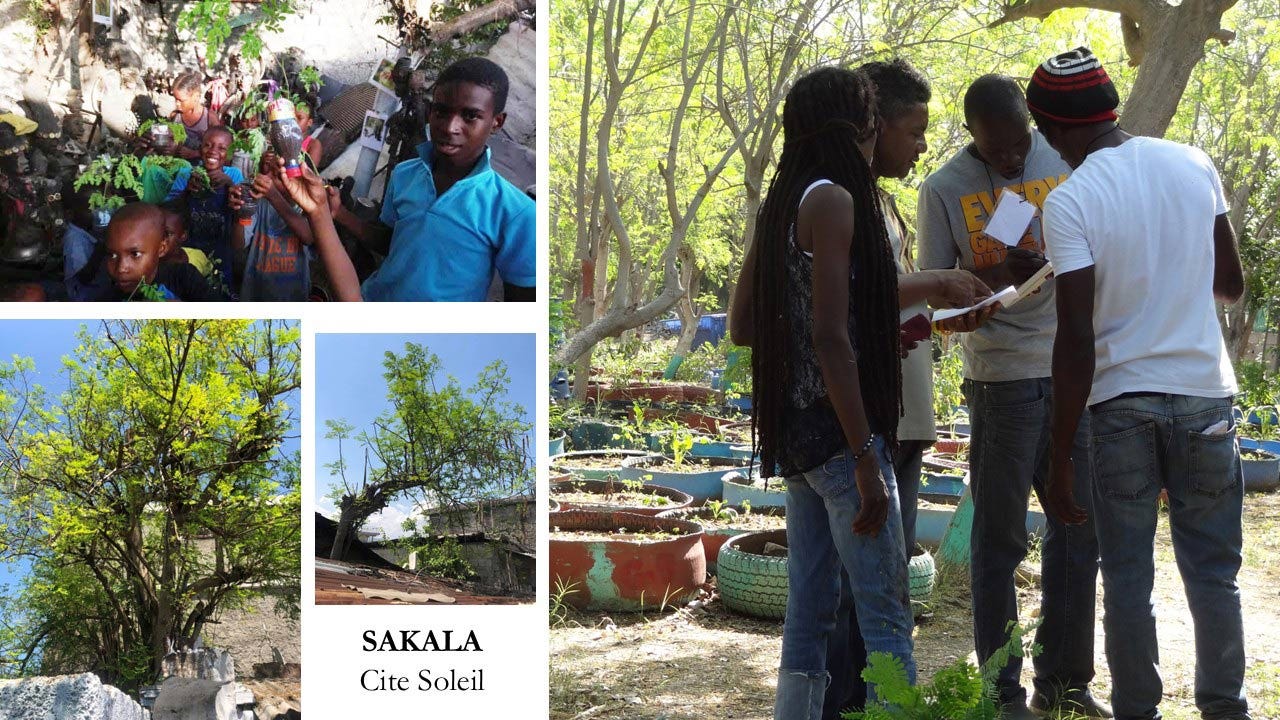
My collaborators offer the most inspiration for me. I admire the people I work with and feel honored to be able to learn from the folks whom I work with. Kala Greene and her late mother Grace Stiles have influenced the way narratives should be broadened to include diverse histories. The grandmothers with whom I cooked during the Ghetto Biennial in the red zone along Grand Rue in Port-Au-Prince taught me how much wisdom may be held by people dismissed for being illiterate or poor.
Our relationship with Penobscot linguist Carol Dana taught me the dynamic nature of the land and through Buddhism we cultivated an understanding of how Indigenous practices should be integrated into restoration work, with the caveat that we need to approach Indigenous populations with awareness of the genocide that took place against them. Only by recognizing harms done may we proceed in healing relations with each other and the habitats in which we dwell. And, of course, my son is my teacher in ways to weave motherhood into a larger practice of care for the world.
What keeps you coming back to continue what must be challenging work?
Celebratory activism around shared tables is an idea coined by Slow Food International. I serve on the Slow Food Denver chapter board because I believe this approach is the ultimate expression of love. Love for family, appreciation for culture and connection with the land. It is less of a challenge and more of an enjoyable way of strengthening communities. We are inclined to participate in what we enjoy doing, so we focus on engaging people in working together toward solutions instead of fighting against challenges.
Thank you, Lee Lee! If you’d like to learn more about Lee Lee and her work, you can find her online:
Collaborative Works: www.virtualvoices.org
Visual art: www.lee-lee.com
Instagram: @seed.disperse, @TAOSdistillery, and @eire.lee