
Nowhere Else I'd Rather Be
Featuring: Juliana Ramirez

Sometimes the rules and traditions embedded within art and science can help us ask new questions, allowing us to more clearly see what needs to change. Traditional printmaking, for example, relies on solvents and other harsh chemicals that are hazardous to the health of humans, other animals, and the wider world we live in.
But does it have to be that way? I just taught a printmaking class at Hawk Mountain Sanctuary, coincidentally using many of the same eco-friendly materials that this month’s guest, Juliana Ramirez, mentions. As you’ll see from Juliana’s work, beautiful results layered with story and meaning become possible from an approach that pushes traditional boundaries and expands our sense of what is possible.
What other rules or assumptions might a deeper understanding of art, science, and the interplay between the two allow us to explore? I hope you find inspiration for your own questions and discoveries here!
Featuring: Juliana Ramirez
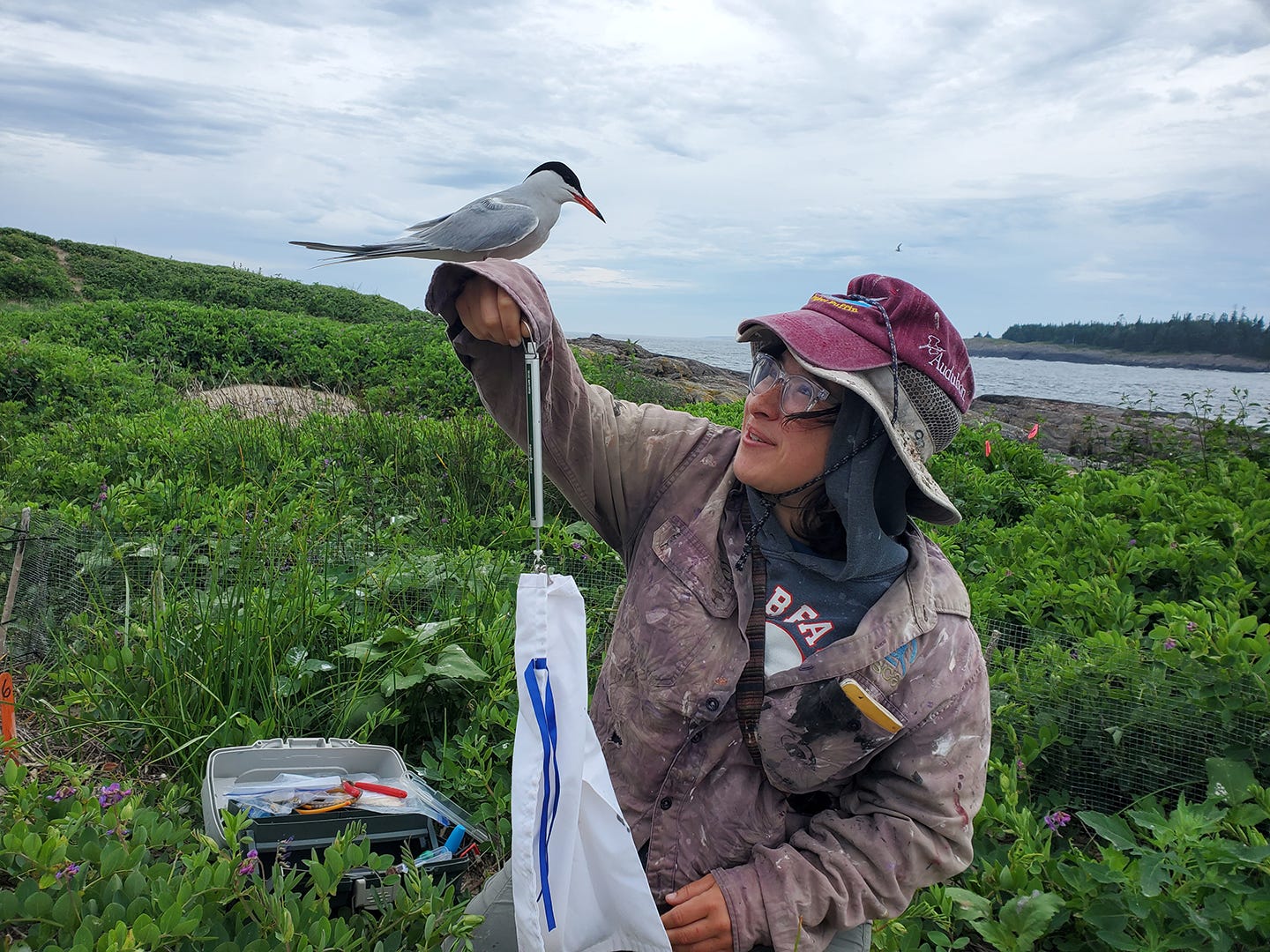
Welcome, Juliana! Could you tell us about your work?
I am a non-toxic printmaker and field biologist with a passion for seabirds. I tend to spend my summers working as a researcher on remote islands in seabird colonies, and spend my off-season making art and working various jobs ranging from woodcarving to owl monitoring. As an example, I am currently (while writing this interview) on a dredging boat monitoring for endangered species!
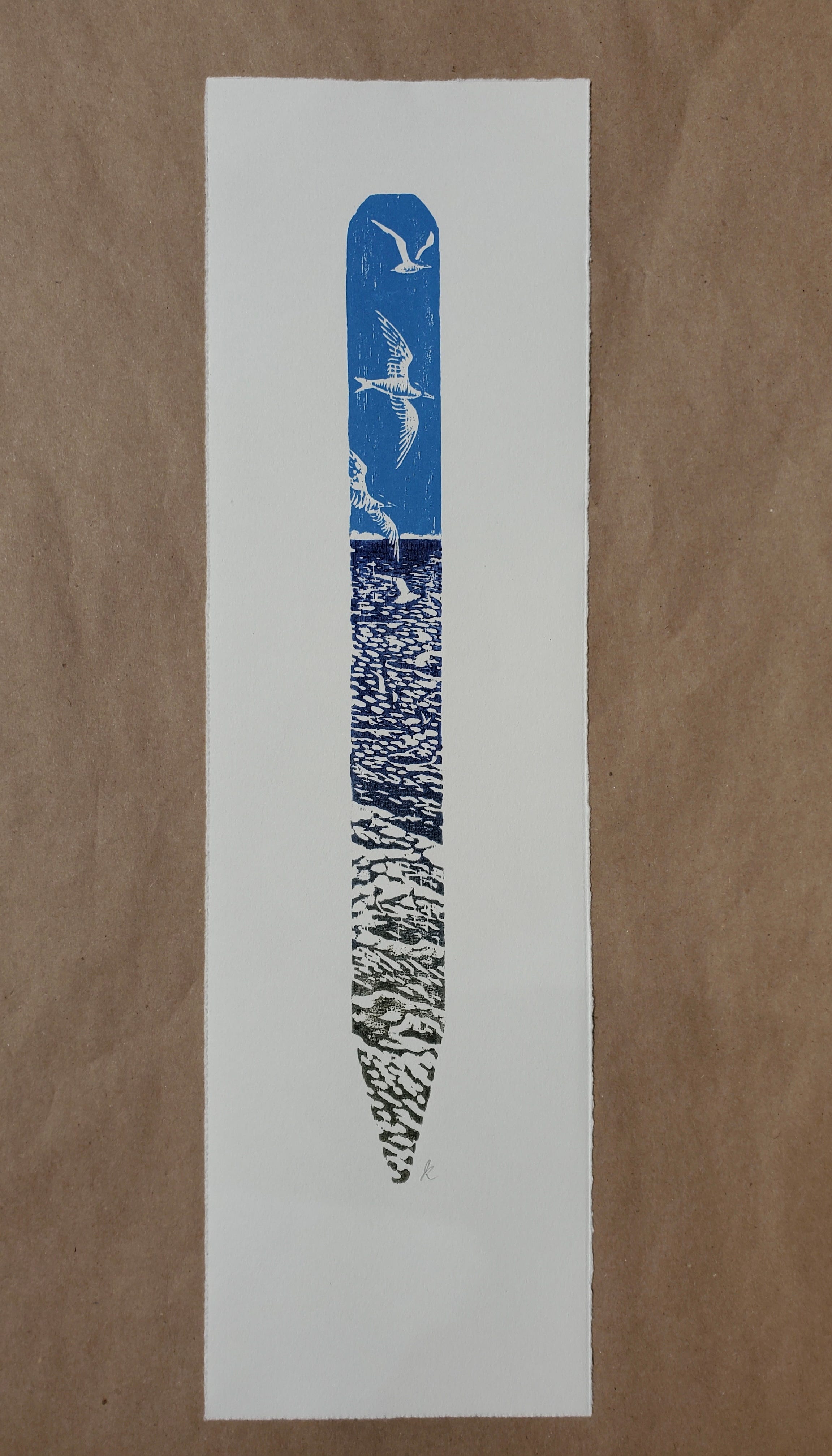
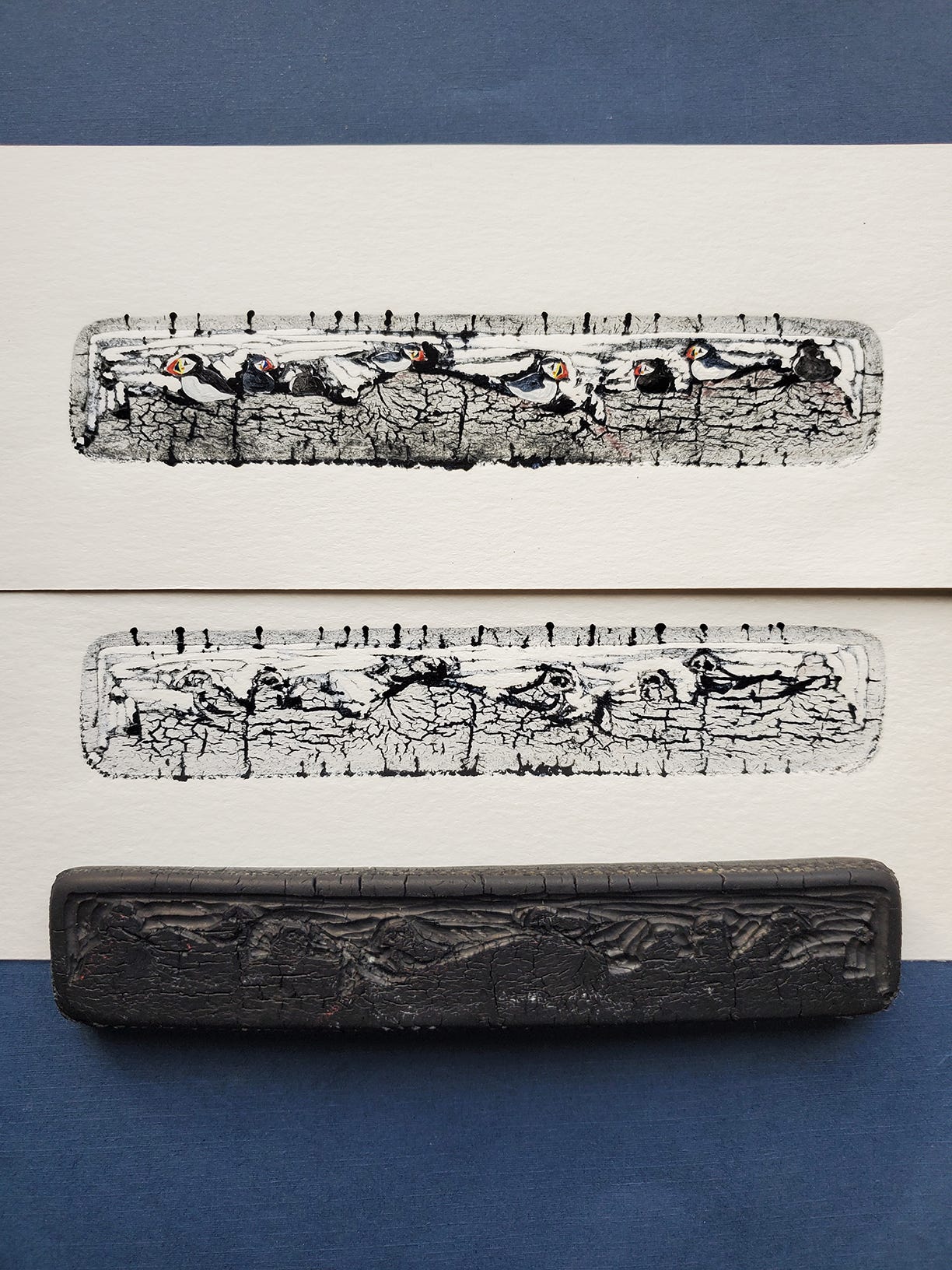
With so many techniques within printmaking, I try my best to be environmentally conscious and end up choosing methods based on potential impact. I gravitate towards woodcut, linocut (using salvaged or recycled material), monotype, collagraph, and drypoint using tetrapak/milk carton material. I also do a bit of sketchbooking, gouache painting, mixed media, woodcarving, and paper cutting. In regards to subject matter I find myself gravitating towards species that I’ve worked with and places I’ve been, almost always working from my own reference material. My goal is to capture the moments I’ve witnessed while out in the field and bring attention to the birds and ecosystems that I care so much for.
There’s so much I’d love to hear about, but could you start by telling us a little more about the animals you work with?
I've worked with almost all of the seabirds that nest in the Gulf of Maine: Common Terns, Arctic Terns, Roseate Terns, Least Terns, Atlantic Puffins, Black Guillemots, Razorbills, and Leach's Storm Petrels. Several of these are endangered, and Arctic Terns have the longest migration out of any animal in the world!
On Midway Atoll, I worked with Laysan Albatross, Black-footed Albatross, Bonin Petrels, Monk Seals, and Laysan Ducks. In other areas, I’ve also worked with Northern Saw-whet Owls and other types of owls, as well as fish, sharks, rays, turtles, and more. They’re all wonderful!
What aspect of your work are you excited about right now?
The intersection between art and science has been fascinating to explore the past couple of years. I took a break from art after college and jumped into conservation work, eventually being inspired by my fieldwork and starting printmaking again. This fresh start brought about new subject matter, concepts, and techniques.
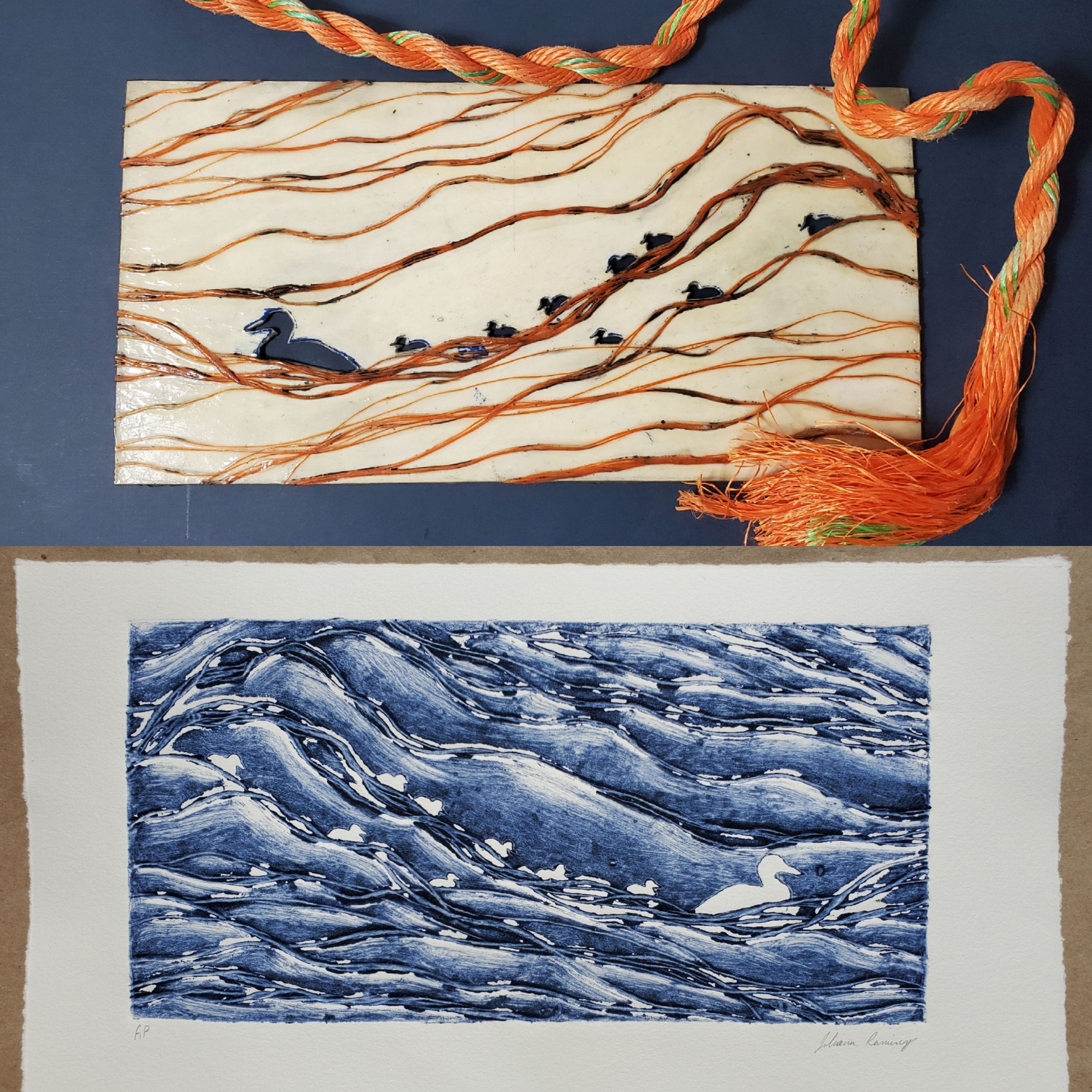
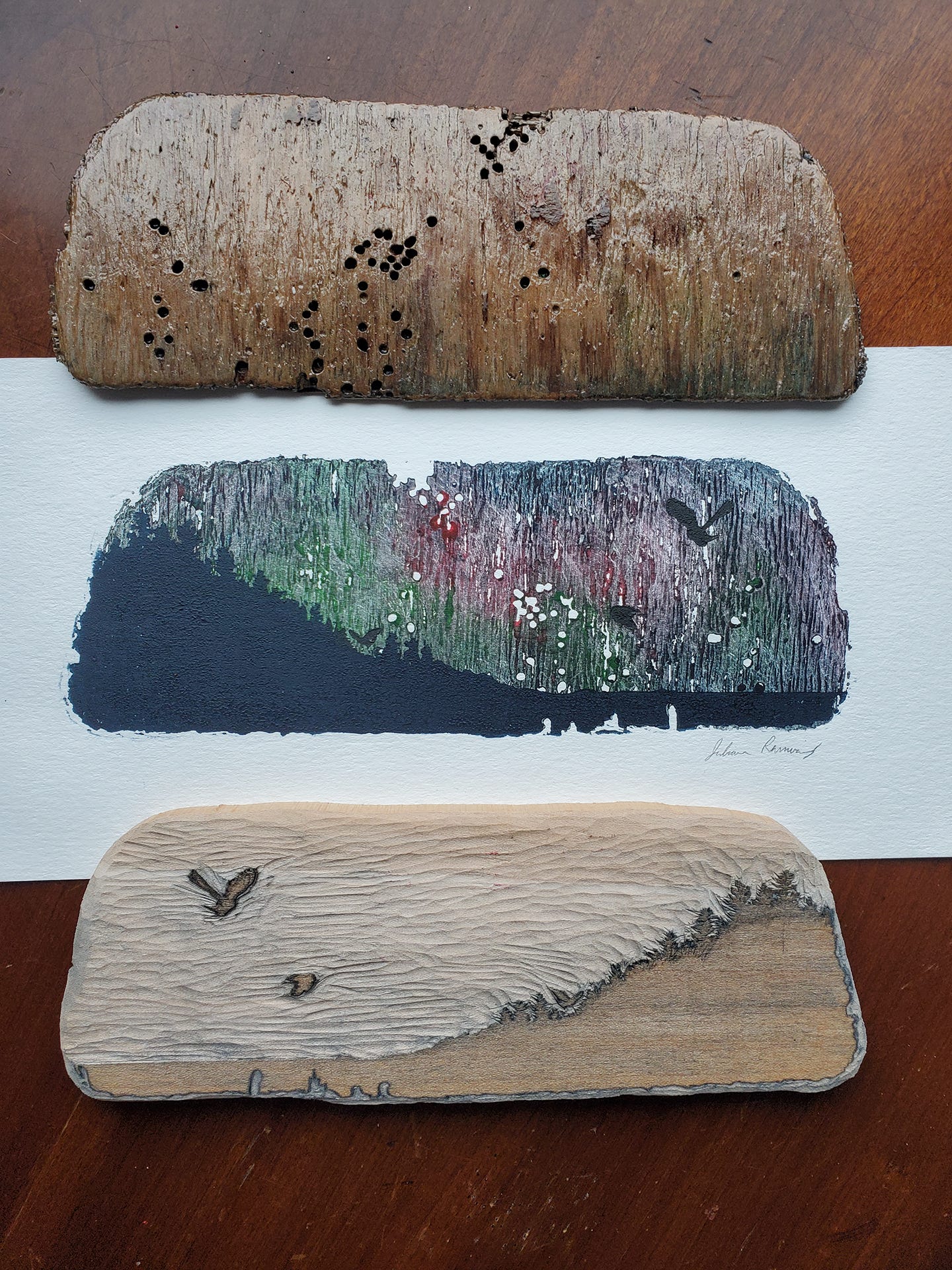
A technique that’s been particularly exciting for me recently is using marine debris and found objects as foundation for my plates! It feels fitting to use objects that I’ve found while out in the field, especially considering these waste items have their own wear and tear from sun, sea, and salt. It feels like a bit of a collaboration with the ecosystem and physical journey that the waste has gone through. I’m happy to take them away from places where they do harm and give them a second life, all while avoiding purchasing newly manufactured materials.
Starting to work with these alternative materials has made me realize that the “rules” that I learned while studying printmaking in school are optional, and much can be accomplished by pushing the limits of the medium. It’s been a real exploration as each piece of marine debris has its own quirks and characteristics, so I’ve spent time experimenting with relief, intaglio, and collagraph techniques.
How are science, art, and writing part of your work, and how is the interaction between these areas important to you?
All of these elements are intertwined, especially due to the fact that I want to spread awareness about the threats that face seabirds and island ecosystems through my art. Inevitably for people to care, they need to be aware and understand. To do that, they need to be shown and educated. It’s all connected, and this intersection feels crucial to what I’m trying to do.
The role that science and art each play in my life has been a constant push and pull, and how exactly to find that balance has been a constant experiment. Although I love my fieldwork, the work can be time consuming and demanding enough that I really don’t have time to work on art—usually just some sketching—let alone a process as extensive as printmaking. Recently I’ve found success with really committing time to work on my art through residencies, making time to work on pieces in between seasonal work, and finding jobs that have structured free time. I recently started doing environmental consulting work out at sea—which has free time that’s surprisingly ideal for my art—so I’m feeling optimistic about the future!
What is your current process of creation and how did you get here? (from Tanisha Negi)
I trained in traditional printmaking while in my undergrad at Binghamton University. Art & Design (concentration in Printmaking) was one of my majors, while the other was Environmental Studies (concentration in Ecosystems). The further along I got in my Environmental major, the more I recognized the negative impact that humans have on the planet. I looked at my art and questioned a) why am I using all of these toxic materials? And b) what am I even making my art for? I spent so much time in the studio that I barely knew what inspired me. I was very proficient at drawing people, but my concepts increasingly strayed away from humanity. I lost inspiration, graduated, and jumped into conservation work.
I explored all sorts of positions—trail building, chainsaw/forestry work, teaching, fisheries observing, etc.— and eventually landed on seabirds. From seabirds came inspiration, and I realized that I could do printmaking in whatever way I wanted to. I went with soy-based and water-based inks and leaned away from methods that required toxic solvents. I explored using waste material in my work—such as milk carton material/tetrapak—and realized that there really are no rules! You can print anything that’s flat enough, and anything can be a plate if you really try. Although plenty of my work is more standard—though still non-toxic—the pieces I’ve made utilizing marine debris have been a fascinating experiment and exploration.
Is there a particular scientific or environmental problem that feels important to you? What do you do about that?
Human impact on birds and the ecosystems is something I massively care about, but it comes in many forms. It’s hard to pick one form really, but marine debris has felt like the most tangible issue to me lately. Almost all bird populations are in decline, ecosystems being encroached upon, the ocean is warming . . . and in the middle of that is all of our garbage. It’s indicative, this sign and symbol of human impact.
My eyes were truly opened to this issue when I worked on Midway Atoll in 2021. As one of the world’s largest albatross colonies, hundreds of thousands of albatross nest on this Northwestern Hawaiian island in the middle of the Pacific. The “Great Pacific Garbage Patch” is a collection of marine debris located within the foraging zones of albatross, who find food for themselves and their chicks on the surface of the ocean.
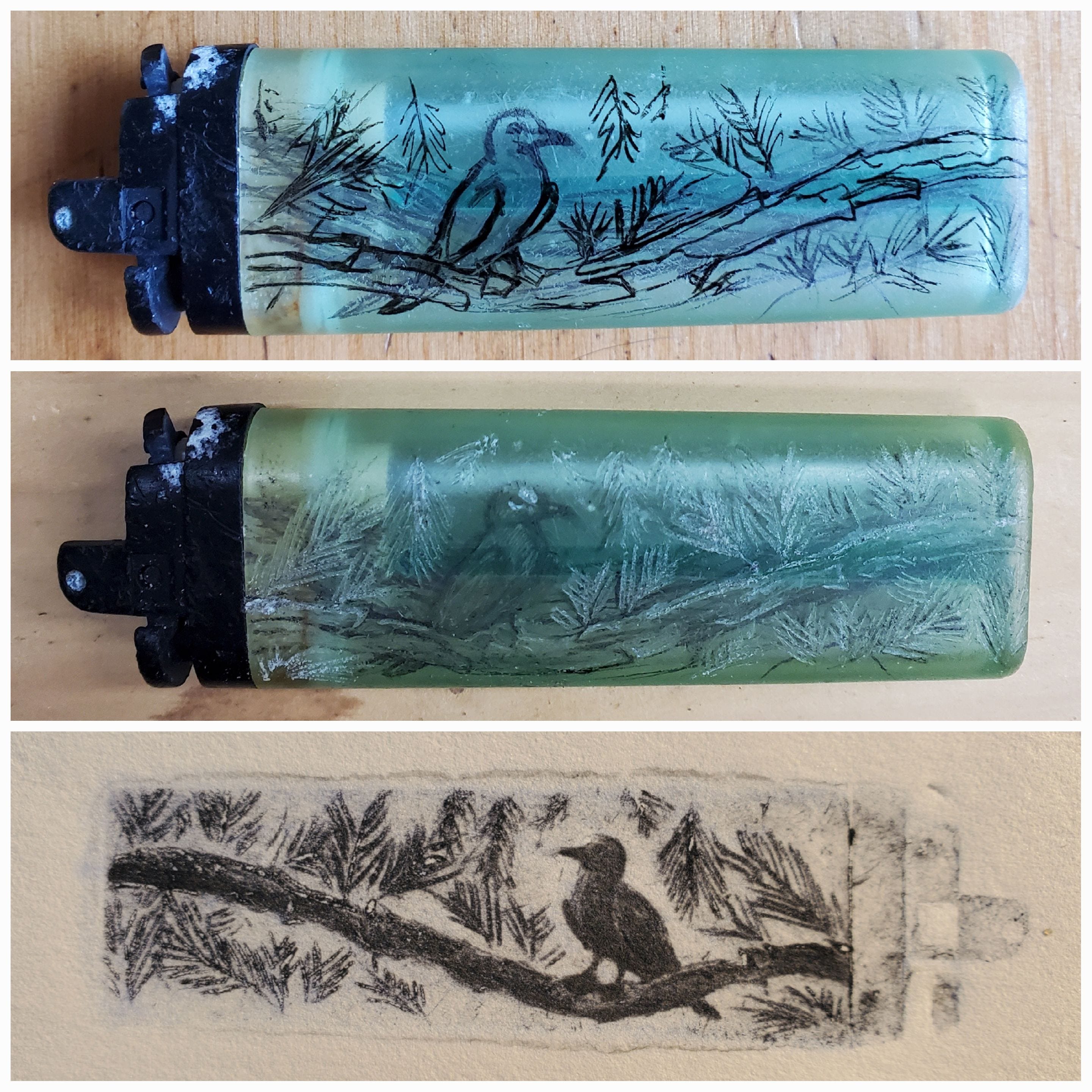
Albatross parents will fly for days to weeks, foraging for nutrient rich food to bring back and regurgitate for their chicks. Instead, they often unintentionally swallow floating plastic. These plastics compound in the stomach of the chicks, who cannot regurgitate the plastics until they are older, or not ever if the plastics are too large. Lighters—a single use item with an air pocket—are one of the most common things to find on Midway, nestled in the rib cages of feathery chick carcasses. I have hundreds of lighters that I collected while there, and I am turning them into collagraph/intaglio plates to depict scenes of my time on Midway. These lighters are suitable as plates because they have flat sides, which I suspect is a more common style of lighter in Asia, where most of the lighters come from due to the counterclockwise nature of the Pacific Ocean gyre. This series is an exception from my other work—which focuses more on Maine/Northeast US species and ecosystems—but served as a catalyst for this concept.
How does your position affect your work?
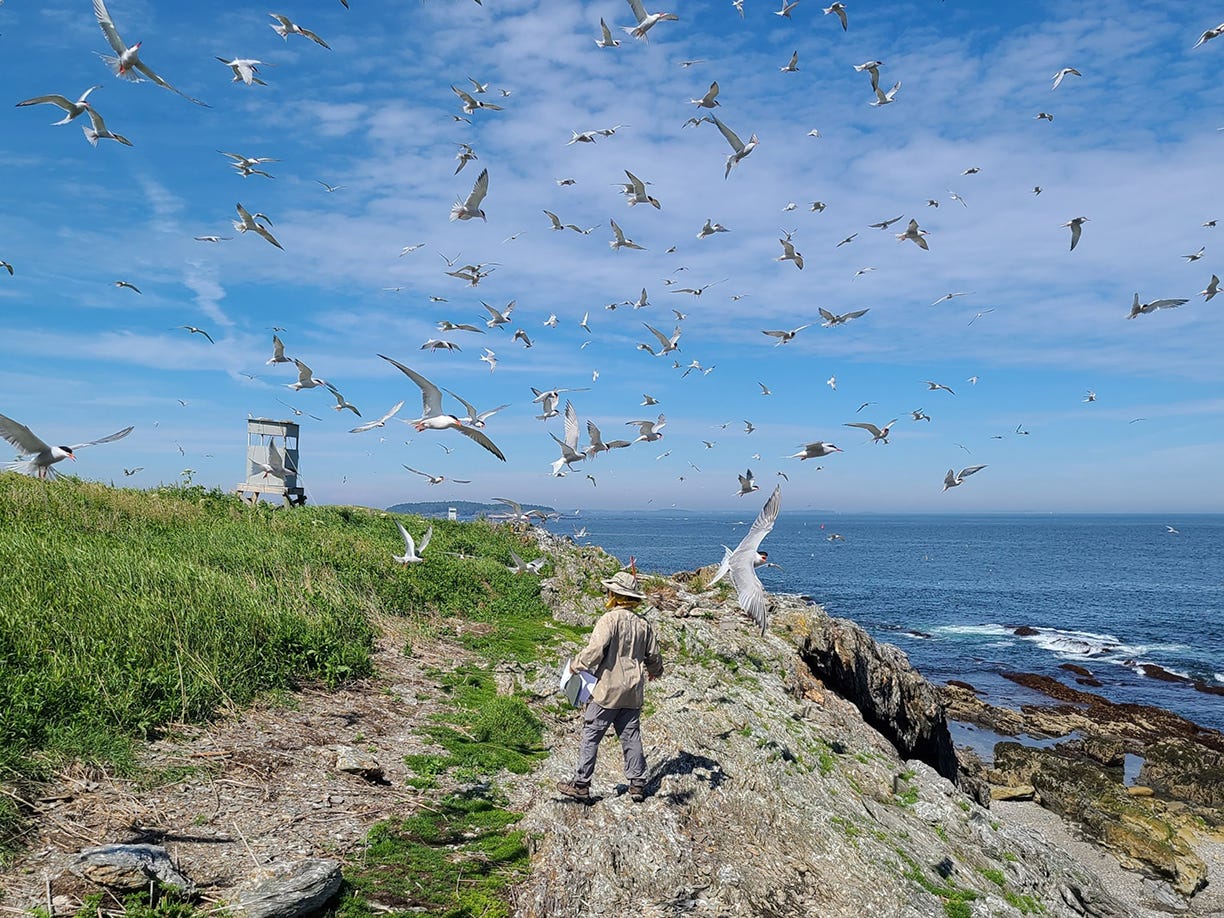
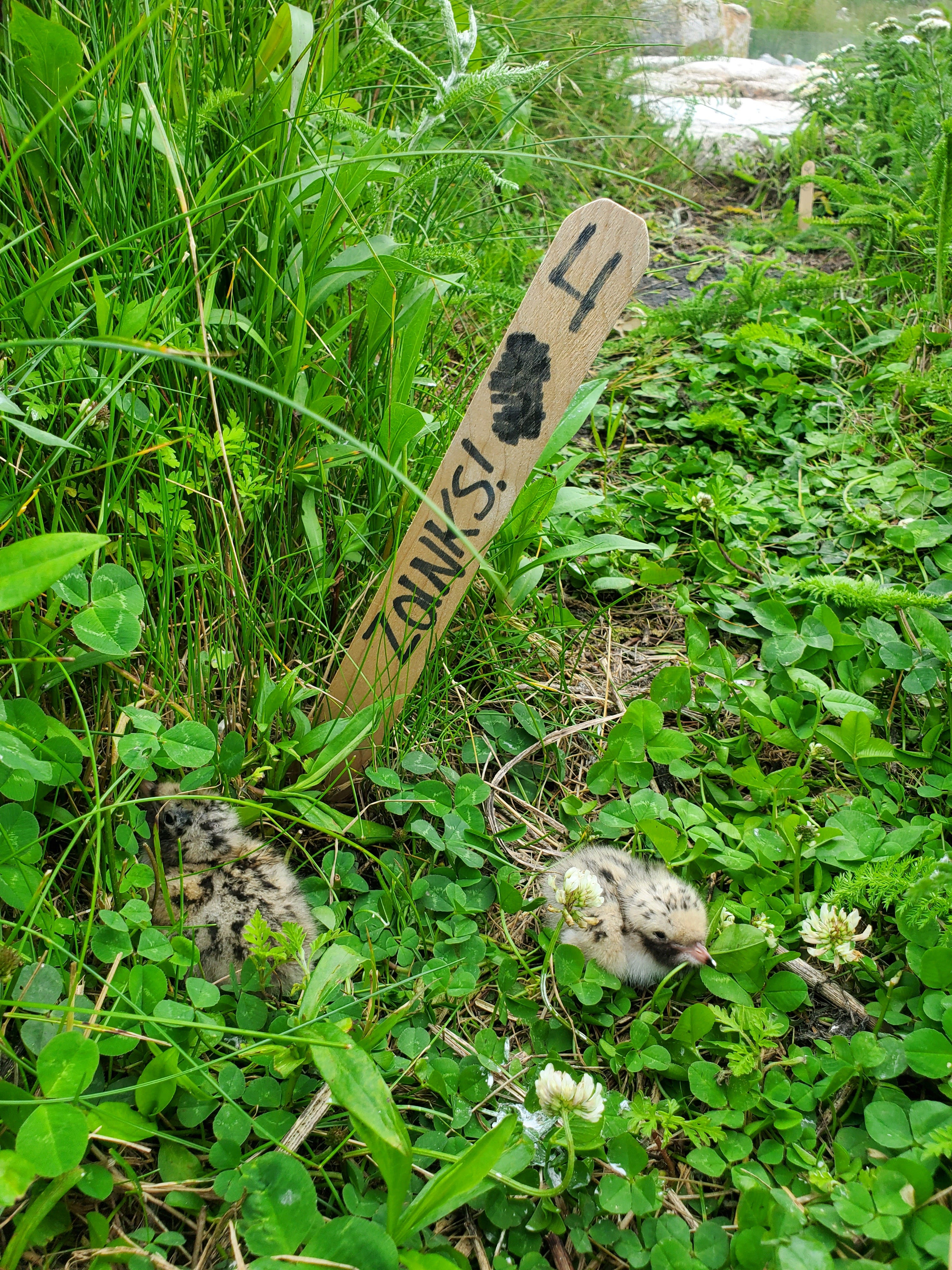
As a field biologist, I am lucky enough to find myself spending most summers on islands surrounded by seabirds. As an artist, I can’t help but fixate on these glimpses into a world so unknown to humans. Birds already live elusive lives, and seabirds even more so. Many of the species I’ve worked with only spend 2 - 5 months out of the year on the islands they nest on, while some of the others are nocturnal.
Thanks to my months spent living alongside seabirds, I get a window into the part of their lives that is accessible, though still isolated from society. I get to see seabirds arrive from their grand migration—some coming all the way from Antarctica—then go through courtship, nest building, egg laying, chicks hatching, foraging for food, feeding chicks, and eventually chicks getting big enough for their first flight. All of the behavior and stories in between those milestones . . . it’s incredible. When following a nest over the season—tracking growth and feedings—we get to know the nests, parents, and chicks. We follow along day to day, hoping for the best and getting excited at seeing success, happy to see a chick getting fed a big fish or learning how to use their wings. I get to watch the island breathe day in and day out as the season moves along, and be a steward along the way. Inevitably living like that, I collect a lot of inspiration.
What else influences and inspires you?
I find myself inspired by others doing the same thing I am: exploring the intersection between art and science. I’ve discovered a couple of amazing people on Instagram who are simultaneously field biologists and artists, and have seen their accomplishments and success. I’ve spent years feeling torn between my two interests, but recently—finding others in the same boat—I’ve seen the benefits of having both under my belt. Instead of not feeling like I’m enough in either category, I can embrace the “and” of them together. I’ve been told by people that I have to choose, and it’s so validating to see those people proven wrong. Not only is it possible, but it is such a valuable way to communicate the environmental issues and species that we are so passionate about.
Separately, I’ve also found inspiration watching Alysa Liu recently. An American figure skater coming back from retirement, she won gold the way she wanted to: full of joy, artistry, and originality. Alysa is the daughter of an immigrant, and I can’t help but think about all of the good and potential that she represents. As the daughter of a (legal) immigrant myself, Alysa makes me want to be the best version of myself and achieve my dreams.
What has been your biggest barrier to working across the intersection of science, art and writing? Do you wish these could be more integrated for you, or do you intentionally keep them separate? (from Kate Howlett)
My biggest barrier isn’t all that exciting: time and money. I spent years saying I’d make art in my off season, only to feel/be obligated to get a job. For example, I moved to Maine in 2021 and found work at the Wendell Gilley Museum, which is a bird woodcarving museum. Perfect blend, right? Well, the longer I lived in Maine, the more I worked at the museum. The more I worked at the museum, the less time I had to work on my personal art. I think it was something I had to learn, a lesson to listen to my instincts and what I want.
Ever since then, I’ve decided that if I’m going to take art related jobs, it’s only going to be for my own art. Mostly meaning, artist residencies! I’ve found great success with having defined time allocated for my art this past year through residencies and think I’ve finally found a flow that works for me. Even still, it all takes so much time! Especially trying to do both fieldwork and art. I’ve accepted that it’s just going to take me longer to do the things I want to do, and I can’t see myself giving up one or the other. I feel lucky to get to do both, and hope that I can only keep improving the balance between my passions.
Who is your best self and why? (And are you that person now, or if you are not, then what would make you your best self?) (from Roseann Hanson)
I am my best self when I’m working out on seabird islands. It’s a dream come true, getting to live as a human animal alongside thousands of seabirds. It’s just a certain kind of simple out there: I wake up with the birds, do my research tasks for the day, cook and eat meals, process data, make observations, and go to bed with the sun. Everything I need is right there with me, in such a beautiful place. Especially while working on a crew, life and the duties it takes to live in such a place are communal. We all work together, having a good time and putting in hard work. It rarely feels like work and when I’m there, and there’s nowhere else I’d rather be. It makes me my best self because it’s the closest I get to living as I “should”: in nature and not getting caught up in the stress of society and the modern world.
Thank you, Juliana!
Juliana has just launched Confusedgull, her own Substack! Just like Twig & Ink, it’s free to read and subscribe. You can also learn more about Juliana and her work on Instagram or her website.
MAKING-WITH Mentorship Showcase 2026
Please join us for the Creature Conserve Mentorship Showcase! I will be presenting The Nature of Collaborative Vision (online) on Friday, March 27th, at 6pm ET as part of the opening evening.
On Saturday, we’ll honor the tremendous accomplishments of our Mentees as they present art-driven solutions for some of conservation’s most pressing problems.
The entire showcase is free and open to the public! You are welcome to join us for as much as you’d like. Here’s the link to register, full schedule below.
PRESENTATION SCHEDULE
Friday, March 27, 2026
Opening Presentations, 6:00 PM - 8:00 PM ET
Lisa Kahn Schnell, Diana Renn, Ana Sofía Camarga, Derek Russell
Saturday, March 28, 2026
Mentee Panel (3) Presentations and Q&A, 8:00 AM ET - 2:00 PM ET
Panel 1: Bridging Ecologies Through Connections, ET 8:00 AM - 9:45 AM ET
Soundarya Gottapu, Emi Koch, Audacia Ray, Luna Tescari
Panel 2: Interpreting Nature, Creating Voices, 10:00 AM - 11:45 AM ET
Akshita Totlani, Layla Osman, Manya Singh and Aditi Patil, Marie Preston
Panel 3: Managing Conservation, 12:00 PM - 1:30 PM ET
Megan Elevado, Merrica Fernando, Valentina Caceres
How fortunate for Juliana to be able to spend time working in a place and being able to say there is no place else she would rather be. She certainly has made many good choices in her life to reach this point