
Unguarded
Branching out 022

Here in the northern hemisphere, it’s spring. Happy spring!
Today I’m sharing “Unguarded,” which was originally published in the Uncivilized Art issue of Dark Mountain (Issue 28).
Please consider this a sampler from the book, and if you’re able, go purchase a copy of the entire thing. It’s full of thought-provoking and inspiring art and writing from around the world, including work by Thomas Little and Aaron Ellison, both of whom have been guests on Twig & Ink. You can learn more on the Dark Mountain Project webpage, or their Substack.
“Unguarded” (and the book, along with some of my other recent work), is also on view at the art show eco-conspiracies at Galleries on Downing in Denver, Colorado. Thank you to Twig & Ink guest Lee Lee Leonard for curating this show.
Unguarded
Walnut trees sweep across the hillside. They’re up by the house too, and in the dark, deep, damp soil by the creek below. We’ve tried to eat the nuts, but the shells are so hard and the insides so convoluted that we mostly leave them for the squirrels and other animals. Small trees spring up everywhere.
For the first few years after we moved in, the vegetation stayed low enough that we sledded down the slope with our girls, careful to avoid the trunks and rough, braided bark. Now, groundhog holes and arcs of raspberry canes would make sledding impossible. And the girls are grown.
Black walnuts produce juglone, a chemical responsible for allelopathy; it keeps other plants from growing nearby, creating more space for the tree. Sometimes I wish I had such powers, and other times I fear I already do. I love the fruits especially for their fragrant green husks – lemony and spicy and earthy. I carry one along on autumn walks, to inhale deeply, to calm me when I feel shredded. The older husks require nothing more than boiling and straining – and a willingness to get messy – to make a lovely warm brown ink. Over the years, I have made gallons of it.
I walk down the hillside path alone, past the blue-green cluster of mountain mint I planted a couple of summers ago, under the unruly arms and tender red leaves of a young oak, past ferns that look like tiny ladders and around a groundhog hole, finally to the deer path that leads to the clearing and the creek and the little wooden-plank bridge across it. A breeze rocks the trees gently.
*
Nothing else feels gentle right now. The world feels hard and quick and jagged and violent. I mourn the bird with iridescent feathers lying on the road next to the wetland, the warehouses that force their low, wide bulk onto soft farm fields, the bittersweet vines that strangle and engulf the spicebush, the maples, the walnuts. I am a mother with no children at home, a wife whose husband’s body is attacking itself with cancer, a knowledge holder and a maker in a world that places little value on either. Everything feels broken, divided, torn. I search endlessly for ways to knit it back together again. I research, write, make art. I mentor, teach and volunteer. I am a mother, sister, wife, daughter, worker. How many strands can one person hold? Sometimes I grip them too tightly, roar with frustration, because I can’t keep track, can’t securely hold them all, can’t create anything when I’m so clenched.
The descent down the hillside, and especially crossing the creek, releases my senses from their tangle of words and worries. It’s not far, but each moment of the journey – from the flicking tail of the phoebe when I step out the door, to the bone-white limbs of the sycamore tree against the sky and the swish of wind on my skin – lifts me away from the crumbly shale ledges of my mind.
*
Over the last year I explored ways to encourage scientists and artists to meet as equals. As yellowed walnut leaves spun to the ground and winter held us tight, I interviewed, read, scribbled notes into distended notebooks. How might we meld experiences, knowledge and resources in a way that will carry us through the ecological and biological crises we face, to a place none of us could have imagined alone? Where to begin? How do we ask questions, and how can we recognize a response if we don’t speak the same language?
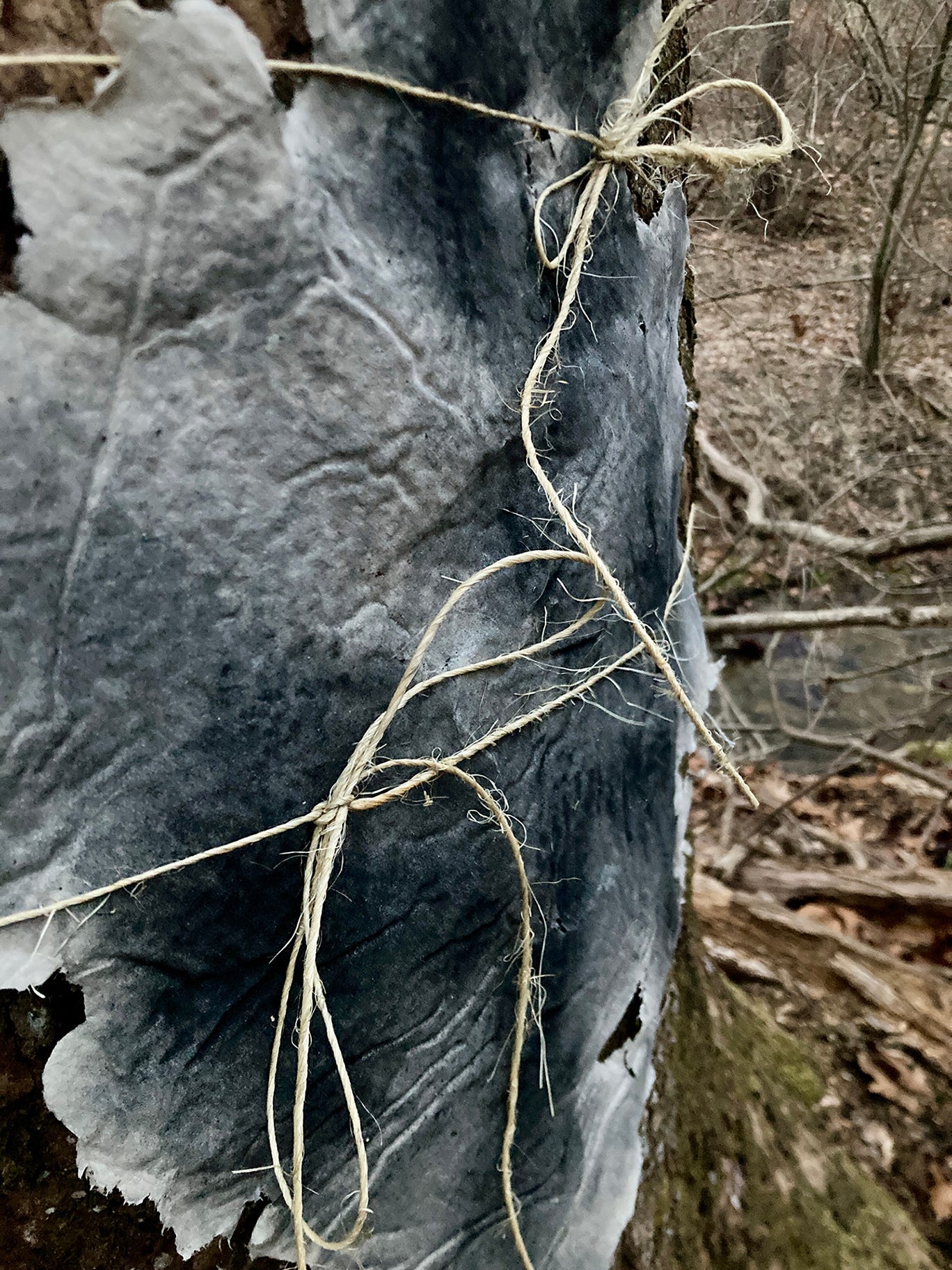
Exhausted by my own ineffectiveness, I ejected myself into the gathering dusk of a February afternoon, into the wind and cold, the cries of geese overhead. Using my hands and a feather from our hens, I smeared handmade walnut ink and charcoal onto several large sheets of cotton printmaking paper, tied it onto trees, and waited.
*
Now I peek at a piece of paper that has weathered sleet and sun, gusts and squalls, transforming into a shawl-shaped sculpture over the limbs of a thin tree. The marks I scrawled with homemade charcoal remain visible, but muted. I watch this piece and the others, palpable evidence of my investigations. Through my weird-paper-tied-to-trees project, as I’ve come to call it, confusion has tempered into curiosity.
Like any collaboration, I don’t know what this paper, or my other experiments in communicating with the landscape and its inhabitants, will become. Could conversations transpire on its soft surface? What traces and tracks might invite my participation? In mid-March, I noticed a moth sheltering in its folds; now, a tiny insect with the delicate curves of a ballerina, wings held over its back, and three thin tails that extend the arc of its abdomen. Ephemeroptera, I discover.
I continue down the hill. Over the years, what initially seemed a wall of green has resolved into names and known places. We’ve yanked garlic mustard, climbing roses, and stiltgrass, pried out honeysuckles, bittersweet, and tree of heaven. In their place we nestle in ferns, bluebells, Jacob’s ladder, mayapples. The plants don’t always stay where we put them. They move, spread, shift, disappear. This intensity of observing and knowing, guiding and being guided – in a moment, and over time – dissolves the boundaries between ourselves and these other lives. But up at our house, glassy and bright, perched on the parched shale hill, it’s easy to forget. We place a pink flag with each new planting so we’ll know where to meet again next time.
No place is more familiar than the little opening just over the bridge. I’ve found plenty of flowers that grow just fine under walnut trees, including wild ginger, with its velvety leaves that hide burgundy flowers, wood poppies the color of goldfinches, and a little patch of ramps – wild leeks – a gift from a friend when we picked our children up from elementary school one spring afternoon over a decade ago. We ate a couple of the leeks, and I planted the rest. They’re spring ephemerals, so I don’t always catch them, but this year I find them strappy and strong, pale in the mid-April sun.
*
We have new neighbours. We haven’t talked much beyond casual greetings, but they seem nice. One night a few weeks after I installed the first pieces of paper, I heard the whine of what sounded like a vehicle stuck in the snow. It turned out to be an ATV, spinning through the low, wet area near our property line. I returned to warmth and closed the door, but couldn’t escape the sound.
The older woman who used to live there spent sunny afternoons with her fingers dug into the soil of her flower beds. She let the wetland go wild, and after her grandsons drifted away from the creek toward theater, cars and college, she almost never went down there. For nearly two decades, we rarely thought about boundaries.
Something has irrevocably changed. My silence, my peace, my refuge – it all feels violated and impossible to put back together again, just when everything else is falling apart, being dismantled, disappearing as I watch. It seems civilised to respect their rights. But whose civilisation am I guarding?
*
I find wasps in the sculptural paper and step away, shift my gaze to the creek. Across the bridge, the scene is disorienting. Branches shifted and broken, patches of bare soil. I kneel where the leeks were, follow an arc of exposed earth as it loops around a nearby walnut tree. A few pale leaves remain, but most of the leeks, too close to the property line, are pulverized by the fresh ATV track. In a moment, what years had grown, gone.
Early one morning I plant fresh flags so I might find my way back again, so the plants might recover, so the neighbours might know the bare truth of my desperation to protect whatever I can from whatever is coming.
*
I avoid the border; it feels like a wound. I visit the sycamore, our sentinel tree, the one our girls used to call the parsley tree because of the funny way its leaves gather at the top, soaring over the walnut trees below. It’s more central, but harder to reach now that it’s surrounded by a phalanx of skunk cabbage, leaves fully extended and laced with the webs of tiny spiders. I’ve started making my own paper, and remnant fibers from the piece I’d tied on weeks earlier – and removed after just one day – still cling to the patchwork of bark, so I don’t add more.
What can I offer? I trim away shrubby weeds near the tree’s base. I try to tread lightly, but I feel gangly and awkward and large. I sit close, eat my lunch and wonder. Maybe trees are just really big ears, the earth’s way of listening. Maybe the birds sit and sing because the trees listen, stay open. Does civilisation say we should be closed to everything other than what we define as ourselves?
A catbird perches and chatters nearby, but startles and zips away when I shift to look at it. The whir of hummingbird wings stills me, but the bird is gone before I see it. Who am I to them? Does anything change for the tree or the birds, the soil or the creek, the bees or flies or stones because I’m listening? Does anything change for me? I can’t tell if the tree knows I’m there, but I thank it. Back up at the house, I find twigs in my hair.
*
We plod up our driveway, watch the neighbour’s halting approach.
‘Those flags,’ he asks, ‘are they the property line?’
‘Oh,’ I mutter, dip my head, ‘I meant to talk to you first.’ I explain about the leeks, try to keep it friendly. We hadn’t had a chance to stop by, and anyway, I wasn’t sure how to say it. Please, don’t make it worse. Please let me keep something whole. Please let me love something that lasts.
*
Grief is not civilised. It is raw, uncontrollable, energy that has nowhere to go, a demand that we stop in our tracks. I don’t know how to deal with my own grief or anyone else’s, but simultaneously feel the impossibility of not trying. We all live within an illusion of control anyway; grief breaks past that wall and shows us how thin it really is.
But here, at least, I can initiate the conversation. I tie paper onto trees, ask these beings I’ve known for so long, but only superficially, for their stories, the ones that let me learn and love, and make clear what I’m losing. Will weather make marks? Will the gestures of wasps and woodpeckers leave tracks, tears, tangible traces? Grief allows a moment to look around, connect, start to heal. It catches you, insists you take what you require, and holds you still, keeps you safe, while you do. It becomes a material on which to stitch and weave and create something, maybe something beautiful, from the destruction of what was.
*
Trout lilies. Wood poppies. Wild ginger. Blue cohosh and black. Spicebush. Jack-in-the-pulpit. Walnut trees and tulip poplar. The sycamore. A morel once. Mayflies. Fireflies. On a thick July night, a dobsonfly. Swallowtails. Luna moths. Monarchs. Baltimore oriole. Indigo bunting. Brown thrasher. Rose-breasted grosbeak. Catbird. Bluebird. Goldfinch. Wrens. Red-bellied woodpecker. White-throated sparrow. Fox. Rabbit. Squirrels, flying and grey. Raccoon. Opossum. Deer.
‘Oh,’ says the neighbour, sincere and innocent as a flower. ‘I thought there was nothing down there.’
*
Am I, like the walnut trees, allelopathic? Do I put something out into the world that says stay away, that makes it difficult to get close? Maybe. Probably. At least sometimes. But I’m also sometimes good at stillness, watching, quiet dreaming.
I gesture, and hope the meaning becomes clear. I listen with paper smeared with handmade charcoal and walnut ink, and egg yolk from our hens. When I drive up to the house one evening, a squirrel flees toward a nearby tree, then scampers off in a different direction when it catches sight of the paper tied to it. I park and pull the paper off the tree. I want to open the passage, not block it. What happens when we listen, to each other, and to the more-than-human world? How does that act of care and attention change us, and our perception of how we can hold the things we love together?
*
That wasn’t the end of the conversation with the neighbour. He said he loved it here. It’s such a beautiful area.
‘Yes,’ I said, ‘Let’s go for a walk sometime. Let’s see what else is down there.’
Inspiring!
Love animals and nature. Can't wait to see your view on the animal Kingdom.
For wellness recipes or tax law student certification, come along with me and ask basic tax scenerio questions or gain a new energy dish. Here's my link:
https://substack.com/@taxandtoast?utm_source=share&utm_medium=android&r=7qps0g